

ES

AWS enterprise AI infrastructure push at Re:Invent
AWS enterprise AI infrastructure push at Re:Invent
AWS's enterprise AI infrastructure push introduces Nova Forge, Frontier Agents, chips and factories — reshaping how companies control AI.
AWS's enterprise AI infrastructure push introduces Nova Forge, Frontier Agents, chips and factories — reshaping how companies control AI.
4 dic 2025


ES
How AWS’s enterprise AI infrastructure push is reshaping business AI
The AWS enterprise AI infrastructure push is changing how companies think about AI strategy. In simple terms, AWS unveiled a broad set of tools and services that make it easier for businesses to build, run, and govern AI at scale. Therefore, organizations that want to use AI for customer service, product development, or internal automation are now facing new choices about control, cost, and data protection. This post walks through the announcements, their likely impact, and what leaders should consider next.
## AWS enterprise AI infrastructure push: a big, coordinated move at Re:Invent
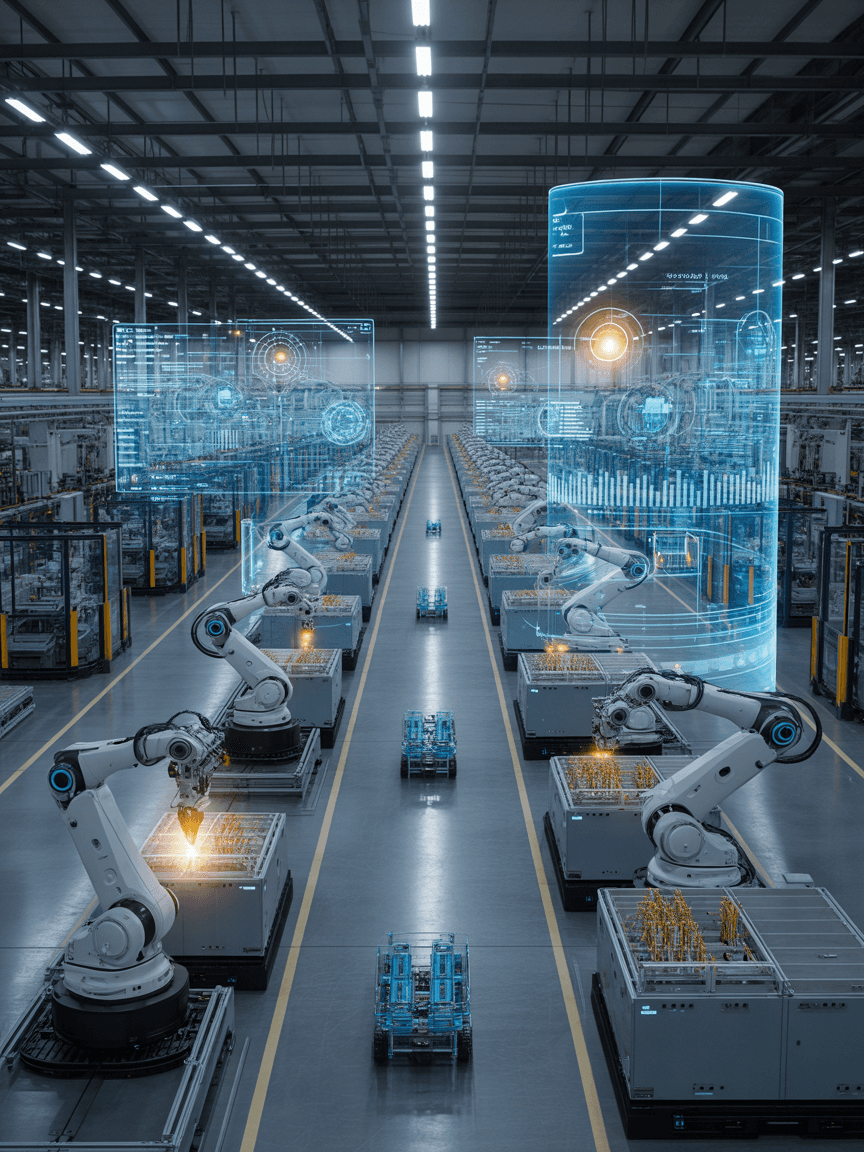
AWS used Re:Invent to present a package of enterprise-focused AI capabilities. The company rolled out new generative models, AI agents, a model creation service, “AI factories,” and even custom silicon. Additionally, these pieces are meant to work together so companies can move from experiments to production faster. Therefore, the announcement is not a single product update; it is a platform-level push to make AI part of core enterprise infrastructure.
Why this matters: companies that already run business systems on AWS will find tighter integrations and more options to process sensitive data inside their clouds. However, this also forces procurement and strategy teams to reassess vendor relationships and data governance. For example, teams must decide whether to adopt managed services that speed deployment or build custom models that keep full data control. Moreover, new AWS chips hint at a long-term plan to reduce costs and improve latency for large AI workloads.
Impact and outlook: expect a faster move from isolated pilots to enterprise deployments. Therefore, teams should update architecture reviews, security playbooks, and vendor contracts. Additionally, cloud and procurement leaders must weigh the benefits of deeper AWS integration against multi-cloud and data portability concerns.
Source: AI Business
AWS enterprise AI infrastructure push: Nova Forge and the case for custom models
Nova Forge is AWS’s new service for creating custom models that incorporate a company’s own data while keeping the strengths of existing foundational models. In practice, this means firms can tailor model behavior without losing the broad capabilities that large pre-trained models provide. Therefore, Nova Forge aims to bridge the tradeoff between customization and foundation-model performance.
For business leaders, this is significant. First, companies that handle sensitive or proprietary information can now build models that reflect their data and policies. Second, retaining foundational capabilities means businesses do not have to start from scratch; they gain speed without sacrificing quality. However, adopting custom models still requires careful planning. Teams must prepare high-quality data, set up appropriate testing and validation, and define governance rules. Additionally, operational aspects like monitoring, retraining, and cost control remain important.
Impact and outlook: Nova Forge could shift enterprise strategy toward more owned and controlled AI. Therefore, legal and compliance teams should be involved early. Moreover, IT organizations should consider whether to centralize model development or empower individual business units. Finally, enterprises should pilot Nova Forge with a clear set of success metrics, because customized models can deliver competitive value — but only when managed properly.
Source: AI Business
AWS enterprise AI infrastructure push: Frontier Agents and the rise of autonomous workflows
Frontier Agents are AWS’s new autonomous agents that can perform multiple tasks and complete work with minimal intervention. In simple terms, these agents are software workflows that act on behalf of users and systems. Therefore, they can automate complex, multi-step processes that previously required human coordination.
From an enterprise perspective, this opens practical automation opportunities. For example, agents could handle customer service escalations, coordinate data updates across systems, or run routine IT tasks. However, introducing agentic systems changes how organizations design processes. Companies must define clear guardrails, escalation paths, and monitoring to ensure agents act within policy and ethics guidelines. Additionally, teams will need new skills to test and supervise autonomous workflows.
Impact and outlook: expect automation to move from narrow, human-triggered scripts to broader, persistent agents that manage end-to-end tasks. Therefore, operations leaders should map high-value workflows and identify where agents can safely add efficiency. Moreover, legal and security teams should define accountability models, because agent decisions may have downstream business effects. Finally, well-managed agents can free human teams for creative work, but only if oversight and measurement are built in from day one.
Source: AI Business
Nvidia’s open reasoning model and the implications for physical autonomy
Nvidia’s Alpamayo-R1 is an open reasoning model introduced at NeurIPS and designed to advance Level 4 autonomy in self-driving vehicles. Therefore, this model aims to give machines more human-like reasoning abilities for on-road decision-making. Moreover, making such a model open signals a shift toward broader collaboration in the development of complex autonomous systems.
For businesses in automotive and edge devices, the possibility of higher-level autonomy changes product roadmaps. However, Level 4 autonomy brings technical, regulatory, and safety challenges. Companies will need to integrate sensing, control, and robust validation processes to meet real-world demands. Additionally, open models reduce barriers for experimentation, but they also require skilled integration teams to tune systems for local markets and compliance needs.
Impact and outlook: the arrival of reasoning-focused models will accelerate plans for advanced driver assistance and other autonomous applications. Therefore, vehicle makers, suppliers, and regulators must work together on testing frameworks and safety standards. Moreover, enterprises building edge AI systems should watch how open models influence certification, tooling, and hardware requirements. Finally, those in logistics or mobility should reassess timelines for deploying autonomy in controlled environments first, and then scale as capabilities and regulations mature.
Source: AI Business
EY and NVIDIA: a practical pathway to physical AI in industry
EY and NVIDIA announced a physical AI platform to help companies test and deploy robots, drones, and other smart devices. Additionally, EY is opening an EY.ai Lab in Georgia and adding leadership to support deployments. Therefore, this move represents a consulting-led approach to bringing AI into the physical world with vendor tooling and structured support.
Why this matters to businesses: moving AI into physical systems adds layers of complexity compared with cloud software. Companies must handle hardware integration, safety testing, field trials, and change management. However, a joint platform built with NVIDIA tools and EY’s industrial know-how aims to shorten that path. Moreover, having a lab and advisory team helps firms run pilots and translate results into operational plans.
Impact and outlook: expect more firms to experiment with robots and drones in retail, warehousing, inspection, and service roles. Therefore, leadership should prioritize clear use cases with measurable ROI and safety protocols. Additionally, partnerships like this indicate a maturing market for physical AI services — one that combines consulting, hardware, and software. Finally, businesses that plan for workforce transition, regulatory compliance, and scaled operations will capture value faster.
Source: Artificial Intelligence News
Final Reflection: Connecting platforms, models, agents, and the physical world
Together, these announcements form a coherent picture: cloud providers, chipmakers, and consultancies are aligning to make enterprise AI practical, controllable, and operational. Therefore, AWS’s enterprise AI infrastructure push ties platform, model creation, and autonomous agents into a single ecosystem. Meanwhile, Nvidia’s reasoning models and EY’s physical AI platform extend those capabilities into vehicles, robots, and edge devices. The result is an expanding set of options for companies to embed AI into products and operations.
However, with new capabilities come new responsibilities. Organizations must update governance, data strategies, and safety practices. Additionally, they must decide how much control to retain versus how much to outsource. Finally, those that combine clear business goals with careful governance will likely realize the biggest benefits. Overall, the next 12–24 months should see enterprise AI move from experimental to essential — provided leaders balance ambition with prudence.
How AWS’s enterprise AI infrastructure push is reshaping business AI
The AWS enterprise AI infrastructure push is changing how companies think about AI strategy. In simple terms, AWS unveiled a broad set of tools and services that make it easier for businesses to build, run, and govern AI at scale. Therefore, organizations that want to use AI for customer service, product development, or internal automation are now facing new choices about control, cost, and data protection. This post walks through the announcements, their likely impact, and what leaders should consider next.
## AWS enterprise AI infrastructure push: a big, coordinated move at Re:Invent
AWS used Re:Invent to present a package of enterprise-focused AI capabilities. The company rolled out new generative models, AI agents, a model creation service, “AI factories,” and even custom silicon. Additionally, these pieces are meant to work together so companies can move from experiments to production faster. Therefore, the announcement is not a single product update; it is a platform-level push to make AI part of core enterprise infrastructure.
Why this matters: companies that already run business systems on AWS will find tighter integrations and more options to process sensitive data inside their clouds. However, this also forces procurement and strategy teams to reassess vendor relationships and data governance. For example, teams must decide whether to adopt managed services that speed deployment or build custom models that keep full data control. Moreover, new AWS chips hint at a long-term plan to reduce costs and improve latency for large AI workloads.
Impact and outlook: expect a faster move from isolated pilots to enterprise deployments. Therefore, teams should update architecture reviews, security playbooks, and vendor contracts. Additionally, cloud and procurement leaders must weigh the benefits of deeper AWS integration against multi-cloud and data portability concerns.
Source: AI Business
AWS enterprise AI infrastructure push: Nova Forge and the case for custom models
Nova Forge is AWS’s new service for creating custom models that incorporate a company’s own data while keeping the strengths of existing foundational models. In practice, this means firms can tailor model behavior without losing the broad capabilities that large pre-trained models provide. Therefore, Nova Forge aims to bridge the tradeoff between customization and foundation-model performance.
For business leaders, this is significant. First, companies that handle sensitive or proprietary information can now build models that reflect their data and policies. Second, retaining foundational capabilities means businesses do not have to start from scratch; they gain speed without sacrificing quality. However, adopting custom models still requires careful planning. Teams must prepare high-quality data, set up appropriate testing and validation, and define governance rules. Additionally, operational aspects like monitoring, retraining, and cost control remain important.
Impact and outlook: Nova Forge could shift enterprise strategy toward more owned and controlled AI. Therefore, legal and compliance teams should be involved early. Moreover, IT organizations should consider whether to centralize model development or empower individual business units. Finally, enterprises should pilot Nova Forge with a clear set of success metrics, because customized models can deliver competitive value — but only when managed properly.
Source: AI Business
AWS enterprise AI infrastructure push: Frontier Agents and the rise of autonomous workflows
Frontier Agents are AWS’s new autonomous agents that can perform multiple tasks and complete work with minimal intervention. In simple terms, these agents are software workflows that act on behalf of users and systems. Therefore, they can automate complex, multi-step processes that previously required human coordination.
From an enterprise perspective, this opens practical automation opportunities. For example, agents could handle customer service escalations, coordinate data updates across systems, or run routine IT tasks. However, introducing agentic systems changes how organizations design processes. Companies must define clear guardrails, escalation paths, and monitoring to ensure agents act within policy and ethics guidelines. Additionally, teams will need new skills to test and supervise autonomous workflows.
Impact and outlook: expect automation to move from narrow, human-triggered scripts to broader, persistent agents that manage end-to-end tasks. Therefore, operations leaders should map high-value workflows and identify where agents can safely add efficiency. Moreover, legal and security teams should define accountability models, because agent decisions may have downstream business effects. Finally, well-managed agents can free human teams for creative work, but only if oversight and measurement are built in from day one.
Source: AI Business
Nvidia’s open reasoning model and the implications for physical autonomy
Nvidia’s Alpamayo-R1 is an open reasoning model introduced at NeurIPS and designed to advance Level 4 autonomy in self-driving vehicles. Therefore, this model aims to give machines more human-like reasoning abilities for on-road decision-making. Moreover, making such a model open signals a shift toward broader collaboration in the development of complex autonomous systems.
For businesses in automotive and edge devices, the possibility of higher-level autonomy changes product roadmaps. However, Level 4 autonomy brings technical, regulatory, and safety challenges. Companies will need to integrate sensing, control, and robust validation processes to meet real-world demands. Additionally, open models reduce barriers for experimentation, but they also require skilled integration teams to tune systems for local markets and compliance needs.
Impact and outlook: the arrival of reasoning-focused models will accelerate plans for advanced driver assistance and other autonomous applications. Therefore, vehicle makers, suppliers, and regulators must work together on testing frameworks and safety standards. Moreover, enterprises building edge AI systems should watch how open models influence certification, tooling, and hardware requirements. Finally, those in logistics or mobility should reassess timelines for deploying autonomy in controlled environments first, and then scale as capabilities and regulations mature.
Source: AI Business
EY and NVIDIA: a practical pathway to physical AI in industry
EY and NVIDIA announced a physical AI platform to help companies test and deploy robots, drones, and other smart devices. Additionally, EY is opening an EY.ai Lab in Georgia and adding leadership to support deployments. Therefore, this move represents a consulting-led approach to bringing AI into the physical world with vendor tooling and structured support.
Why this matters to businesses: moving AI into physical systems adds layers of complexity compared with cloud software. Companies must handle hardware integration, safety testing, field trials, and change management. However, a joint platform built with NVIDIA tools and EY’s industrial know-how aims to shorten that path. Moreover, having a lab and advisory team helps firms run pilots and translate results into operational plans.
Impact and outlook: expect more firms to experiment with robots and drones in retail, warehousing, inspection, and service roles. Therefore, leadership should prioritize clear use cases with measurable ROI and safety protocols. Additionally, partnerships like this indicate a maturing market for physical AI services — one that combines consulting, hardware, and software. Finally, businesses that plan for workforce transition, regulatory compliance, and scaled operations will capture value faster.
Source: Artificial Intelligence News
Final Reflection: Connecting platforms, models, agents, and the physical world
Together, these announcements form a coherent picture: cloud providers, chipmakers, and consultancies are aligning to make enterprise AI practical, controllable, and operational. Therefore, AWS’s enterprise AI infrastructure push ties platform, model creation, and autonomous agents into a single ecosystem. Meanwhile, Nvidia’s reasoning models and EY’s physical AI platform extend those capabilities into vehicles, robots, and edge devices. The result is an expanding set of options for companies to embed AI into products and operations.
However, with new capabilities come new responsibilities. Organizations must update governance, data strategies, and safety practices. Additionally, they must decide how much control to retain versus how much to outsource. Finally, those that combine clear business goals with careful governance will likely realize the biggest benefits. Overall, the next 12–24 months should see enterprise AI move from experimental to essential — provided leaders balance ambition with prudence.





CONTÁCTANOS
¡Seamos aliados estratégicos en tu crecimiento!
Dirección de correo electrónico:
+5491173681459
Dirección de correo electrónico:
sales@swlconsulting.com
Dirección:
Av. del Libertador, 1000
Síguenos:





CONTÁCTANOS
¡Seamos aliados estratégicos en tu crecimiento!
Dirección de correo electrónico:
+5491173681459
Dirección de correo electrónico:
sales@swlconsulting.com
Dirección:
Av. del Libertador, 1000
Síguenos:
CONTÁCTANOS
¡Seamos aliados estratégicos en tu crecimiento!
Dirección de correo electrónico:
+5491173681459
Dirección de correo electrónico:
sales@swlconsulting.com
Dirección:
Av. del Libertador, 1000
Síguenos:
Suscríbete a nuestro boletín
© 2025 SWL Consulting. Todos los derechos reservados


Suscríbete a nuestro boletín
© 2025 SWL Consulting. Todos los derechos reservados