
Enterprise AI at the Edge: Chips, Models, Momentum
Enterprise AI at the Edge: Chips, Models, Momentum
Enterprise AI at the edge is reshaping compute, robotics, automotive and data markets with new chips, open models, and secure edge networks.
Enterprise AI at the edge is reshaping compute, robotics, automotive and data markets with new chips, open models, and secure edge networks.
Jan 8, 2026

Enterprise AI at the Edge: What Leaders Need to Know Now
Enterprise AI at the edge is no longer a niche experiment. In the first weeks of 2026, vendors and partners announced moves that change how companies buy chips, run models, and protect data outside the cloud. This blog unpacks those announcements in plain language. Therefore, you’ll get a clear view of how chips, open models, robotics, automotive deployments, and supply chains fit together for business leaders.
## Why enterprise AI at the edge matters now
Interest in enterprise AI at the edge has moved from pilots to practical rollouts. Datavault AI’s expanded collaboration with IBM and Available Infrastructure shows why. They plan to deploy a fleet of synchronized micro edge data centers — called SanQtum AI — running IBM’s watsonx products on a zero-trust network. This setup aims to process, score, and tokenize data where it is created, in New York and Philadelphia first. Therefore, enterprises with sensitive or latency-sensitive workloads can avoid public cloud risks. They can also convert raw inputs into authenticated digital assets in near real-time.
This is important for businesses that handle media, identity verification, credentialing, or regulated data. The architecture combines GPU-rich edge hardware, watsonx models, and a zero-trust approach. It promises both speed and security. However, it also requires rethinking procurement, operations, and partnerships. Companies must evaluate where to place compute, how to secure data flows, and how to monetize or govern newly tokenized information.
Impact and outlook: expect more industry collaborations that pair software models with edge infrastructure and security frameworks. Additionally, organizations will begin treating data creation sites as strategic compute locations, not just collection points.
Source: IBM Think
Nvidia’s new chips reshape compute choices
Nvidia announced six new AI chips and a set of open models in early January 2026. These launches signal a shift in the vendor landscape. For many years, Nvidia has been the dominant supplier of AI accelerators. Therefore, adding new chips reinforces that position. At the same time, Nvidia introduced open models designed to run broadly across systems. This combination changes the buying calculus for IT leaders.
Why it matters for enterprises: first, a fresh wave of silicon can improve performance and lower latency for on-prem and edge deployments. Second, open models reduce the friction of integrating vendor-provided models into custom stacks. However, these moves also highlight a tricky reality: dependence on a single vendor can become a strategic risk. Companies that lock into one supplier for both chips and models may face negotiation leverage loss, supply bottlenecks, and less flexibility.
What to do next: enterprises should map workloads to hardware needs and test multiple vendor approaches where possible. Additionally, they should consider contracts that protect against supply constraints and promote interoperability. In practice, that means designing stacks that can leverage new accelerators while keeping model formats and orchestration portable.
Impact and outlook: Vendors will continue to bundle hardware and software. However, buyers who prioritize flexibility, resilience, and multi-vendor sourcing will gain an advantage.
Source: AI Business
Physical AI, robots, and enterprise AI at the edge
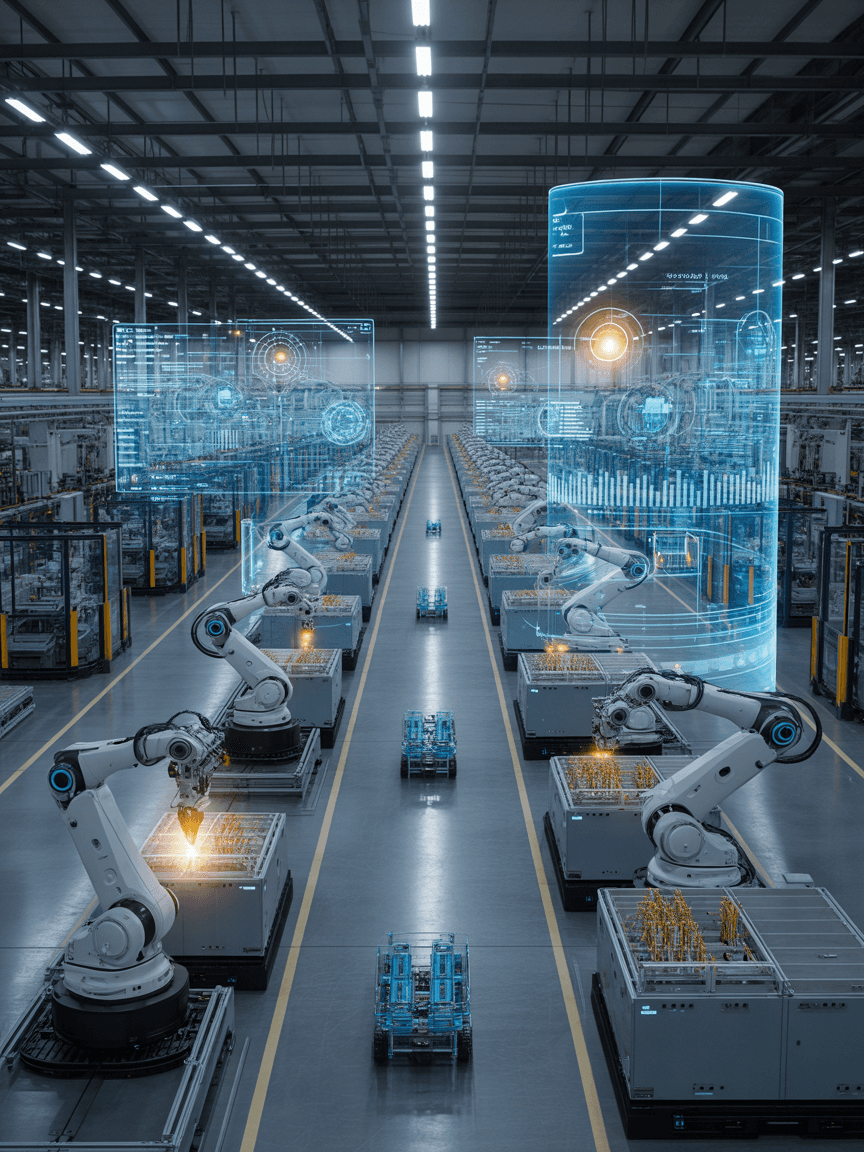
Nvidia also launched “Physical AI” models for robots, together with simulation frameworks and edge hardware. These announcements bring AI into the physical world in a more enterprise-ready way. Robots need local compute and predictable latency to act safely and reliably. Therefore, combining simulation tools, robust models, and edge devices creates a clearer path to deployment.
For businesses in logistics, manufacturing, and warehousing, this matters a great deal. Simulators help engineers test robot behavior before real-world trials. Meanwhile, edge hardware reduces the need to stream sensor data to distant clouds. That cuts latency and improves uptime. Additionally, physical-focused models are designed to handle the messy, long-tail cases that robots face on factory floors or in stores.
Enterprises should pay attention to two practical points. First, integrating robots requires orchestration across networks, models, and hardware. Second, safety and validation processes must be rigorous. Simulation frameworks can reduce risk, but real-world validation remains essential. Therefore, companies should adopt staged rollouts, starting with controlled environments and expanding as confidence grows.
Impact and outlook: robotics will become a more common use case for edge AI. Consequently, firms that invest in simulation, edge infrastructure, and secure model deployment will accelerate automation while controlling operational risk.
Source: AI Business
Automotive: open driving models arrive in production vehicles
Nvidia’s Alpamayo family of open models is set to enter production vehicles, starting with the Mercedes CLA in 2026. These models are designed to address long-tail autonomous driving challenges. In plain terms, they aim to handle the rare or unexpected situations that often break simpler automated systems. Therefore, open models moving into cars is a notable shift.
For automakers and suppliers, this raises a set of strategic questions. Open models can accelerate innovation. They allow multiple teams to collaborate on improvements, and they make it easier to audit behavior. However, putting an open model into a safety-critical product like a car also demands strong governance, validation, and supply-chain assurance.
Operationally, OEMs must integrate software with in-vehicle compute stacks and ensure updates are reliable and secure. Additionally, suppliers that provide sensors, verification tools, or edge compute modules will need to align with the open model roadmap. Therefore, partnerships and standards will become more important. Regulators, too, will pay attention to how these models are tested and updated.
Impact and outlook: expect more collaborations between chip, software, and vehicle makers. As open models mature, they can lower development costs and broaden the pool of innovation. However, safety, provenance, and update mechanisms will be the keys to public trust and commercial success.
Source: AI Business
Securing enterprise AI at the edge amid chip wars
The lessons of 2025’s AI chip wars still shape decisions today. The chip shortage and geopolitical controls taught enterprise leaders a hard truth: semiconductor supply chains and export policies can limit technical roadmaps. Therefore, buying strategies must factor in supply resilience, not just performance or price.
What does that mean for edge deployments? First, enterprises should diversify procurement sources where possible. Relying on one vendor for chips, models, and cloud services can amplify risk. Second, contracts should include delivery guarantees, inventory access, and options for alternate SKUs. Third, companies should plan for phased rollouts that tolerate hardware substitutions.
Security ties into this too. Datavault AI’s SanQtum AI emphasizes zero-trust architecture and on-site tokenization to reduce exposure when data leaves or moves between networks. Therefore, combining supply-chain risk planning with zero-trust deployments creates a stronger posture. Additionally, organizations should validate the provenance of models and chips and keep clear update and rollback plans.
Impact and outlook: procurement teams will become central to AI strategy. They will work closely with architecture and security teams to balance performance, cost, and resilience. Consequently, enterprises that integrate supply-chain thinking into their AI playbooks will be better positioned to scale reliably and securely.
Source: Artificial Intelligence News
Final Reflection: Building resilient, practical AI at the edge
These announcements together tell a clear story: enterprise AI at the edge is maturing from concept to careful, practical deployments. Vendors are shipping new chips and open models. They are also creating tools to run AI in the physical world and in vehicles. Meanwhile, partners are building secure, zero-trust edge networks to keep sensitive data local and fast. However, hardware supply and geopolitical realities remain constraints. Therefore, the companies that succeed will be the ones that pair technical ambition with disciplined procurement, rigorous validation, and strong security.
In the coming year, expect to see more cross-industry partnerships, staged rollouts, and attention to model and chip provenance. Additionally, organizations that design for portability and multi-vendor flexibility will find it easier to adapt when supply or policy shocks occur. Overall, the direction is promising. Edge AI can deliver faster insights, safer automation, and new business models — but it will succeed only when leaders plan for complexity, not just capability.
Enterprise AI at the Edge: What Leaders Need to Know Now
Enterprise AI at the edge is no longer a niche experiment. In the first weeks of 2026, vendors and partners announced moves that change how companies buy chips, run models, and protect data outside the cloud. This blog unpacks those announcements in plain language. Therefore, you’ll get a clear view of how chips, open models, robotics, automotive deployments, and supply chains fit together for business leaders.
## Why enterprise AI at the edge matters now
Interest in enterprise AI at the edge has moved from pilots to practical rollouts. Datavault AI’s expanded collaboration with IBM and Available Infrastructure shows why. They plan to deploy a fleet of synchronized micro edge data centers — called SanQtum AI — running IBM’s watsonx products on a zero-trust network. This setup aims to process, score, and tokenize data where it is created, in New York and Philadelphia first. Therefore, enterprises with sensitive or latency-sensitive workloads can avoid public cloud risks. They can also convert raw inputs into authenticated digital assets in near real-time.
This is important for businesses that handle media, identity verification, credentialing, or regulated data. The architecture combines GPU-rich edge hardware, watsonx models, and a zero-trust approach. It promises both speed and security. However, it also requires rethinking procurement, operations, and partnerships. Companies must evaluate where to place compute, how to secure data flows, and how to monetize or govern newly tokenized information.
Impact and outlook: expect more industry collaborations that pair software models with edge infrastructure and security frameworks. Additionally, organizations will begin treating data creation sites as strategic compute locations, not just collection points.
Source: IBM Think
Nvidia’s new chips reshape compute choices
Nvidia announced six new AI chips and a set of open models in early January 2026. These launches signal a shift in the vendor landscape. For many years, Nvidia has been the dominant supplier of AI accelerators. Therefore, adding new chips reinforces that position. At the same time, Nvidia introduced open models designed to run broadly across systems. This combination changes the buying calculus for IT leaders.
Why it matters for enterprises: first, a fresh wave of silicon can improve performance and lower latency for on-prem and edge deployments. Second, open models reduce the friction of integrating vendor-provided models into custom stacks. However, these moves also highlight a tricky reality: dependence on a single vendor can become a strategic risk. Companies that lock into one supplier for both chips and models may face negotiation leverage loss, supply bottlenecks, and less flexibility.
What to do next: enterprises should map workloads to hardware needs and test multiple vendor approaches where possible. Additionally, they should consider contracts that protect against supply constraints and promote interoperability. In practice, that means designing stacks that can leverage new accelerators while keeping model formats and orchestration portable.
Impact and outlook: Vendors will continue to bundle hardware and software. However, buyers who prioritize flexibility, resilience, and multi-vendor sourcing will gain an advantage.
Source: AI Business
Physical AI, robots, and enterprise AI at the edge
Nvidia also launched “Physical AI” models for robots, together with simulation frameworks and edge hardware. These announcements bring AI into the physical world in a more enterprise-ready way. Robots need local compute and predictable latency to act safely and reliably. Therefore, combining simulation tools, robust models, and edge devices creates a clearer path to deployment.
For businesses in logistics, manufacturing, and warehousing, this matters a great deal. Simulators help engineers test robot behavior before real-world trials. Meanwhile, edge hardware reduces the need to stream sensor data to distant clouds. That cuts latency and improves uptime. Additionally, physical-focused models are designed to handle the messy, long-tail cases that robots face on factory floors or in stores.
Enterprises should pay attention to two practical points. First, integrating robots requires orchestration across networks, models, and hardware. Second, safety and validation processes must be rigorous. Simulation frameworks can reduce risk, but real-world validation remains essential. Therefore, companies should adopt staged rollouts, starting with controlled environments and expanding as confidence grows.
Impact and outlook: robotics will become a more common use case for edge AI. Consequently, firms that invest in simulation, edge infrastructure, and secure model deployment will accelerate automation while controlling operational risk.
Source: AI Business
Automotive: open driving models arrive in production vehicles
Nvidia’s Alpamayo family of open models is set to enter production vehicles, starting with the Mercedes CLA in 2026. These models are designed to address long-tail autonomous driving challenges. In plain terms, they aim to handle the rare or unexpected situations that often break simpler automated systems. Therefore, open models moving into cars is a notable shift.
For automakers and suppliers, this raises a set of strategic questions. Open models can accelerate innovation. They allow multiple teams to collaborate on improvements, and they make it easier to audit behavior. However, putting an open model into a safety-critical product like a car also demands strong governance, validation, and supply-chain assurance.
Operationally, OEMs must integrate software with in-vehicle compute stacks and ensure updates are reliable and secure. Additionally, suppliers that provide sensors, verification tools, or edge compute modules will need to align with the open model roadmap. Therefore, partnerships and standards will become more important. Regulators, too, will pay attention to how these models are tested and updated.
Impact and outlook: expect more collaborations between chip, software, and vehicle makers. As open models mature, they can lower development costs and broaden the pool of innovation. However, safety, provenance, and update mechanisms will be the keys to public trust and commercial success.
Source: AI Business
Securing enterprise AI at the edge amid chip wars
The lessons of 2025’s AI chip wars still shape decisions today. The chip shortage and geopolitical controls taught enterprise leaders a hard truth: semiconductor supply chains and export policies can limit technical roadmaps. Therefore, buying strategies must factor in supply resilience, not just performance or price.
What does that mean for edge deployments? First, enterprises should diversify procurement sources where possible. Relying on one vendor for chips, models, and cloud services can amplify risk. Second, contracts should include delivery guarantees, inventory access, and options for alternate SKUs. Third, companies should plan for phased rollouts that tolerate hardware substitutions.
Security ties into this too. Datavault AI’s SanQtum AI emphasizes zero-trust architecture and on-site tokenization to reduce exposure when data leaves or moves between networks. Therefore, combining supply-chain risk planning with zero-trust deployments creates a stronger posture. Additionally, organizations should validate the provenance of models and chips and keep clear update and rollback plans.
Impact and outlook: procurement teams will become central to AI strategy. They will work closely with architecture and security teams to balance performance, cost, and resilience. Consequently, enterprises that integrate supply-chain thinking into their AI playbooks will be better positioned to scale reliably and securely.
Source: Artificial Intelligence News
Final Reflection: Building resilient, practical AI at the edge
These announcements together tell a clear story: enterprise AI at the edge is maturing from concept to careful, practical deployments. Vendors are shipping new chips and open models. They are also creating tools to run AI in the physical world and in vehicles. Meanwhile, partners are building secure, zero-trust edge networks to keep sensitive data local and fast. However, hardware supply and geopolitical realities remain constraints. Therefore, the companies that succeed will be the ones that pair technical ambition with disciplined procurement, rigorous validation, and strong security.
In the coming year, expect to see more cross-industry partnerships, staged rollouts, and attention to model and chip provenance. Additionally, organizations that design for portability and multi-vendor flexibility will find it easier to adapt when supply or policy shocks occur. Overall, the direction is promising. Edge AI can deliver faster insights, safer automation, and new business models — but it will succeed only when leaders plan for complexity, not just capability.





CONTACT US
Let's get your business to the next level
Phone Number:
+5491133038126
Email Address:
sales@swlconsulting.com
Address:
Av. del Libertador, 1000
Follow Us:





CONTACT US
Let's get your business to the next level
Phone Number:
+5491133038126
Email Address:
sales@swlconsulting.com
Address:
Av. del Libertador, 1000
Follow Us:
CONTACT US
Let's get your business to the next level
Phone Number:
+5491133038126
Email Address:
sales@swlconsulting.com
Address:
Av. del Libertador, 1000
Follow Us:

Subscribe to our newsletter
© 2025 SWL Consulting. All rights reserved